The Haug family's bereavement after Odd's death
Out Stealing HorsesThe Haug family's bereavement after Odd's death is shaped not only by the sudden loss of one twin but by the silence and responsibilities that follow it. Lars has caused his brother’s death accidentally, while trying to imitate Jon with Jon’s gun. In the days that follow, the family’s grief appears in practical decisions, unspoken knowledge, and gestures that cannot undo what has happened. Trond recounts these moments retrospectively, acknowledging that the remembered scene may have acquired details over time even as its central facts remain certain.
The death and its immediate aftermath
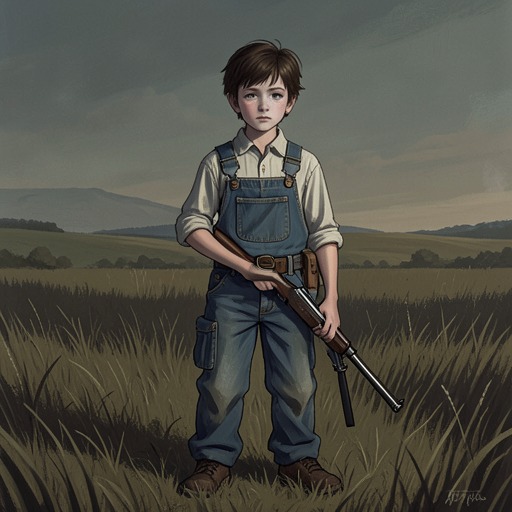
Lars and Odd had spent the morning playing in the basement with discarded clothes and worn shoes. Coming upstairs, they saw the gun and hares hanging in the hall. Jon was their older brother and hero, someone whose actions could be turned into games. Lars reached the gun first, swung it around, and fired while seeking to play at being Jon. The shot struck Odd at close range. Trond’s account explicitly resists the idea that fate had ordained the outcome: the weapon was not guided by destiny, and the church register, where Odd’s death would be recorded, is the only book in which his name could not be crossed out. The accident is therefore presented as both irreversible and humanly caused, not as an event that anyone can explain away as inevitable.
The children’s father found himself facing two immediate realities: Odd was dead, and he had promised to fetch the boys’ mother from Innbygda. He placed Odd on the marriage bed, covered him with a blanket, changed his bloodied clothes, and prepared Bramina, the fifteen-year-old bay horse, for the journey. Lars stood rigid and silent in the hall. Jon, who had been lying still in the meadow, got up and walked toward the stable. Their father seized Jon by the shoulders, later thinking he had done so too roughly, and told him to look after Lars while he was away. He then left for Innbygda, carrying out the commitment he had made before the death occurred. The sequence makes grief inseparable from ordinary obligations: even at the family’s point of rupture, the father must leave, and Jon is assigned care of the brother who has killed the other.
Jon and Lars in the hours of silence
Jon took Lars out in the boat to fish, unable to think of anything else. They were gone for hours. Trond cannot say what the brothers talked about and allows for the possibility that they said nothing, standing apart on the riverbank with their rods and the forest around them. The uncertainty matters: the scene does not give their grief a consoling explanation or turn their time together into a spoken reconciliation. Their return is similarly withdrawn. They went into the barn with their small catch and waited there, without once entering the house.
When Bramina’s hooves and the cart finally sounded on the road, the brothers looked at each other and stood up. They had wanted to remain together a little longer. Then they held hands for the first time since they were very young and went out to meet their father and mother. The gesture marks a brief reconnection between the surviving brothers, but it does not resolve what has divided them. Their father speaks gently to Bramina, words the boys had never heard him use with a person. That contrast places tenderness alongside the family’s inability to speak directly about its loss: care is audible toward the horse, while the human crisis remains largely unspoken.
The mother’s return and the withheld news
Jon’s mother returned from Innbygda in a blue dress patterned with yellow flowers, her handbag on her lap. She smiled at the boys and greeted them as though she had simply come home. Then she asked where Odd was. Jon looked toward his father, but his father did not look back; he stared at the barn wall and chewed silently. He had travelled the long way through the forest with her and had not told her what had happened.
The delay gives the family’s grief a second, distinct shock: the mother arrives home without knowing that one of her sons has died. The evidence does not explain why the father withheld the news, and the silence should not be mistaken for an explanation. Instead, the account fixes attention on the moment when the question is asked and the truth is still absent from the exchange. Jon’s glance toward his father, and the father’s refusal to meet it, make the knowledge unevenly shared even within the family. Loss has already altered the household, but the mother has yet to be brought into that altered reality.
The funeral and its remembered aftermath
Odd’s funeral took place three days later. It was Trond’s first funeral. He recalls that his own mother’s brother had been shot by German forces while trying to escape a police station in Sørlandet in 1943, but Trond had not witnessed that death and did not know whether there had been a funeral. His memory of Odd’s funeral, by contrast, rests on specific things he saw: the avoidance between the two fathers and Lars’s behavior at the grave.
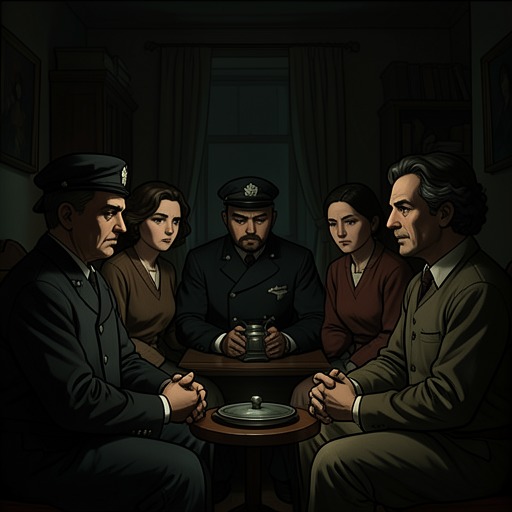
Trond’s father shook the boys’ father’s hand and offered condolences, but the men never looked one another in the eye. The formal gesture did not produce a meeting of gazes. At the open grave, Lars grew increasingly restless as the priest spoke and the small coffin was lowered by ropes. He broke free of his mother and ran among the headstones, then circled near the churchyard wall with his head lowered. As he continued, the priest slowed his speech and the mourners gradually turned away from the coffin to watch him. A neighbor crossed the grass, caught Lars as he ran past, and picked him up; Lars’s legs kept moving, but he made no sound. The scene shows how the funeral’s public ritual is disrupted by a grief that cannot stay still or be contained by ceremony.
Trond looked toward Jon and shook his head slightly. Jon stared back without blinking and gave no sign in return. Trond remembers thinking that he and Jon would never again go out stealing horses together, a thought that made him sadder than anything else at the churchyard. The memory thus extends beyond the Haug household: Odd’s death also marks the end, in Trond’s imagination, of a shared childhood with Jon. After the funeral, Jon went to Innbygda, though the adults did not say what he was doing there and Trond did not ask. During the timber work that followed, Trond worried whether he would ever see Jon again. The family’s bereavement persists not as a single final scene but as separation, unanswered questions, and a remembered closeness whose continuation is uncertain.
Memory, silence, and responsibility
Trond distinguishes the hard fact of what happened from the vivid detail of how he remembers it. He says his father could not have told him every detail and wonders whether he began filling in the scene at once or did so over the years. That admission does not retract the death or the family’s actions; it makes the telling itself part of the aftermath. The reader encounters an event reconstructed through a memory that recognizes its own shaping, while holding fast to the central fact that Odd died and the family had to live with the consequences.
Across the account, the Haug family’s mourning has no single shared expression. The father moves from caring for Odd to fulfilling his promise to collect the mother; Jon takes Lars fishing and later holds his hand; the mother returns uninformed; Lars runs at the grave; and the fathers exchange a handshake without meeting each other’s eyes. These actions do not provide closure. They reveal instead how responsibility, silence, and attachment persist alongside an irreversible loss, and how the surviving brothers’ brief contact becomes one of the few gestures of mutual care in the days immediately after Odd’s death.